Kintamani, Bali · Small-group yoga & quiet retreats Enquire about a class
yogaesthetic

Fundamentals

Yoga exercises: what each posture is actually for

Asana is not a list of shapes to collect. Each family of posture loads the body differently, and knowing which family you are in makes a class far easier to follow — and far safer.

What an asana is

Asana is usually translated as “seat” or “posture”. Patanjali's definition is famously brief: a posture should be steady and comfortable. Note what is missing — no instruction to go deeper, no target shape, no measurement of progress. The classical criterion is whether you can remain attentive in it.

Modern classes use dozens of asanas, most of them codified in the twentieth century. They are grouped by what the body is doing: bearing weight through the feet, folding, extending, rotating, inverting, or deliberately letting go. Understanding the group tells you where the effort should be, which joints need care, and what a sensible counterpose looks like.

A useful rule for any posture: the breath should remain smooth. If you are holding your breath to hold the shape, you have moved past the practice and into a stunt.

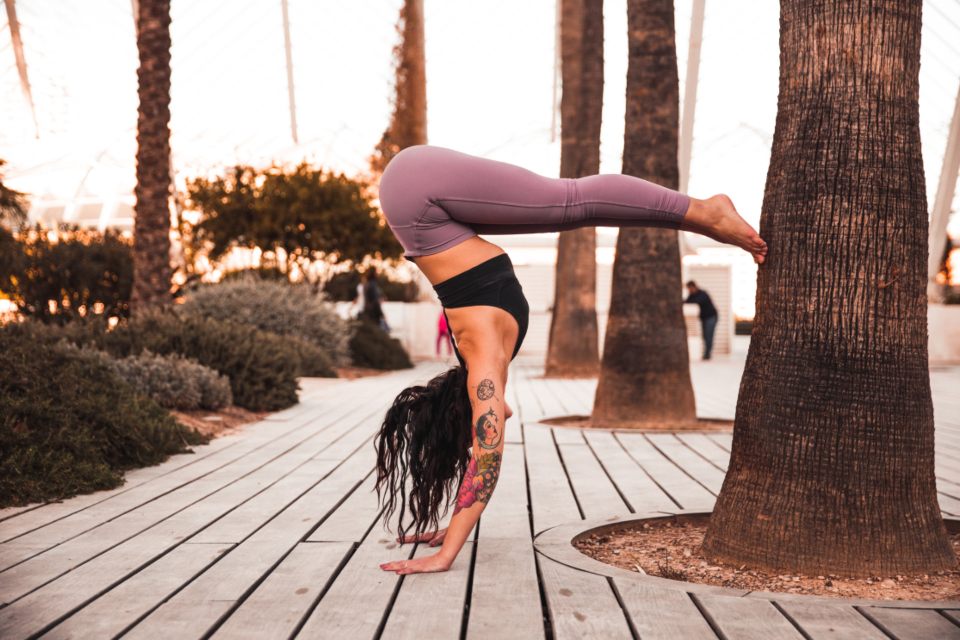
A practitioner balancing in an inverted handstand beside a palm tree on a wooden boardwalk

Lengthening before loading — the order matters

Eight families

The posture categories

Each family has a different job. A balanced class usually touches most of them.

01

Standing postures

Weight travels through the feet, and the whole body organises around gravity. Standing poses build ankle and hip strength, teach you to broaden the collarbones while the legs work, and expose habits — a locked knee, a collapsed arch, a hip that quietly turns out. Examples: mountain, warrior I and II, triangle, extended side angle.

02

Seated postures

The pelvis is grounded, so the spine and hips do the work. Seated poses are where most people discover that “tight hamstrings” is often a pelvic tilt rather than short muscle. Examples: staff pose, seated forward fold, cow face, hero, butterfly.

03

Balancing postures

Balance is an ankle-and-attention skill more than a strength skill. These poses train the small stabilising muscles and reveal how quickly the mind leaves the room. Use a wall without shame. Examples: tree, eagle, half moon, warrior III.

04

Forward bends

Folding at the hips lengthens the back line and invites a quieter nervous system. The hinge should come from the hip joint, not from rounding the lower back under load. Examples: standing forward fold, seated forward fold, downward-facing dog.

05

Backbends

Extension of the spine, opening the front body. The common error is bending from the lower back only; the work belongs in the upper back and hips. Move slowly, and never bounce into end range. Examples: cobra, locust, bridge, camel, upward-facing dog.

06

Twists

Rotation through the spine, usually with a lengthened spine first. Twists are best treated as gentle, progressive rotation from the mid-back — not as a lever to force the neck. Examples: seated twist, revolved triangle, supine twist.

07

Inversions

The heart above the head: legs up the wall, shoulder stand, headstand, handstand. Benefits are real but modest, and the risks are entirely about technique and preparation. Learn these with a teacher, not from a video. Examples: legs up the wall, downward dog (a mild inversion), shoulder stand.

08

Relaxation postures

The part everyone skips and nobody should. Supported rest lets the nervous system register that the practice is over, which is where much of the benefit is consolidated. Examples: savasana, constructive rest, supported child's pose.
Twelve to learn first

A working vocabulary

These cover the families above and appear in almost every class you will attend.

Standing

Tadasana

Mountain pose. Teaches: even weight through both feet, a long spine without rigidity.

Standing

Virabhadrasana II

Warrior II. Teaches: hip opening with a stable base and an unwavering gaze point.

Standing

Trikonasana

Triangle. Teaches: side-body length, and how easily a “straight” leg bends under load.

Balance

Vrksasana

Tree pose. Teaches: that balance is a conversation between foot, hip and attention.

Balance

Virabhadrasana III

Warrior III. Teaches: hip stability through a long lever; humbling on tired days.

Forward bend

Uttanasana

Standing forward fold. Teaches: hinging at the hips, and when to bend the knees.

Forward bend

Paschimottanasana

Seated forward fold. Teaches: the difference between reaching and lengthening.

Backbend

Bhujangasana

Cobra. Teaches: extension from the upper back rather than the lumbar spine.

Backbend

Setu Bandhasana

Bridge. Teaches: glute and hamstring strength under a gentle spinal extension.

Twist

Ardha Matsyendrasana

Half lord of the fishes. Teaches: rotation that starts in the mid-back, not the neck.

Inversion

Viparita Karani

Legs up the wall. Teaches: that a restorative inversion is enough for most evenings.

Rest

Savasana

Corpse pose. Teaches: the hardest skill in yoga — stopping without guilt.

Breathing during exercise

Breath is the metronome of a physical practice. The general convention is simple: exhale as you fold or move into effort, inhale as you lengthen or return. Twists usually exhale on the rotation. Where a teacher says otherwise, follow the teacher — conventions differ between styles.

What matters more than the pattern is that you do not hold your breath. Breath-holding raises blood pressure and signals threat, which is the opposite of what a practice is trying to teach your nervous system. If you cannot breathe smoothly, reduce the range or come out.

Three breaths to know

  • Natural breath. Notice it before changing it. Most people breathe shallowly into the chest.
  • Diaphragmatic breath. The belly and lower ribs expand; the shoulders stay quiet.
  • Extended exhale. Inhale for four, exhale for six to eight. A reliable way to downshift.

Pranayama has its own page if you want the deeper framework; start here with the practical version.

Alignment is not aesthetics

Alignment cues exist to distribute load through joints that are built for it. “Knees over ankles” is not a rule about beauty; it is a way of keeping the knee from taking a shear force it dislikes.

That said, no cue fits every body. Hip sockets differ in depth and angle, femurs differ in length, and some people genuinely cannot bring their heels down in downward dog without collapsing the arches. A good teacher offers a baseline and then adapts it to the person in front of them.

Use a mirror rarely, and a wall, block or blanket often. Props are not training wheels; they are how you find the version of the pose your body can actually hold with a soft face.

Consistency, flexibility and the long game

Flexibility is a slow adaptation of tissue and nervous system, not a decision you make in one session. Three short practices a week will change more than one heroic two-hour class. The research on stretching is unglamorous: modest, gradual gains, best retained when you keep going.

Consistency also protects you. A body that moves regularly tolerates novelty better than one that is sedentary for six days and then ambitious on the seventh.

Safe practice

  • Warm up before depth. Five minutes of movement changes what a joint will accept.
  • Sharp pain is a stop signal. Dull, spreading sensation in a stretch is normal; stinging, pinching or electric sensation is not.
  • Avoid end-range loading of the neck. Shoulder stand and headstand need instruction, not enthusiasm.
  • Tell your teacher about injuries, pregnancy or recent surgery. They can offer a different shape, not a diagnosis.
  • Hypermobile practitioners should train strength, not depth. If you can already go further than most, the work is control.

Common beginner mistakes

  • Chasing the shape in a photograph instead of the sensation in your own body.
  • Letting the breath become shallow or held in order to stay longer.
  • Locking the knees in standing poses, which blocks the ankles and hips from sharing the load.
  • Bending the lower back in every backbend instead of distributing extension upwards.
  • Skipping savasana, which is like ending a meal without swallowing.
  • Doing too much in the first two weeks, then stopping entirely.

If you are starting from scratch, the beginner guide turns all of this into a twenty-minute routine you can do at home. If you are already practising and want to understand what it is doing to you, read the benefits page — with the caveats intact.